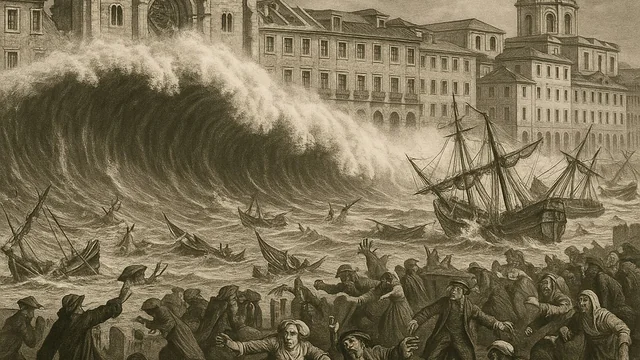
Disaster on All Saints' Day
On the morning of November 1, 1755, All Saints' Day, the city of Lisbon was full of worshippers attending Mass when the ground began to shake violently. The earthquake, now estimated by seismologists at somewhere between magnitude 8.5 and 9.0, struck with an epicenter believed to lie in the Atlantic Ocean southwest of Portugal. Candles lit for the religious holiday tipped over amid the shaking and ignited fires across a city built largely of wood and stone, setting the stage for one of the most studied disasters in European history.
Three Disasters in One Morning
What made the Lisbon earthquake so devastating was not a single event but a cascading sequence of three catastrophes. The initial shaking, which lasted an estimated three to six minutes, toppled churches, palaces, and homes across the Portuguese capital. Survivors who fled toward the open space of the waterfront for safety were then struck by a tsunami, with waves estimated between five and six meters high arriving within roughly forty minutes of the initial quake. Finally, fires that had begun with overturned candles and cooking hearths merged into a firestorm that burned for nearly five days, consuming much of what the earthquake and tsunami had spared.
Estimates of the death toll vary considerably depending on the source and methodology, ranging from roughly 12,000 to as high as 50,000 people in Lisbon alone, with additional casualties reported along the Portuguese, Spanish, and Moroccan coastlines struck by the tsunami. The city's population at the time was around 200,000, meaning a substantial share of residents were killed, injured, or displaced.
A City Rebuilt on Reason
The response to the disaster proved as historically significant as the earthquake itself. Sebastião José de Carvalho e Melo, the Marquis of Pombal and chief minister to King Joseph I, took charge of the recovery with remarkable speed and pragmatism. His famous instruction to the shaken populace, reportedly summarized as burying the dead and feeding the living, set the tone for a rebuilding effort grounded in practical urban planning rather than superstition.
Pombal commissioned military engineers to design a new downtown Lisbon, the Baixa Pombalina, using a grid layout with wide streets and, crucially, a novel building technique now known as the Pombaline cage. This timber lattice framework was embedded within masonry walls to give structures flexibility during seismic shaking, effectively making it one of the earliest examples of earthquake-resistant construction anywhere in the world. Some structures were even tested by having soldiers march around them to simulate tremors before construction proceeded.
Shockwaves Through Enlightenment Thought
Beyond its physical toll, the Lisbon earthquake sent intellectual shockwaves through eighteenth-century Europe. It struck a deeply Catholic, ostensibly pious city on a major religious holiday, prompting philosophers and theologians across the continent to grapple with why a just God would allow such suffering to fall specifically upon churchgoers. Voltaire responded with his poem on the Lisbon disaster and later skewered blind optimism about a benevolent, ordered universe in his satirical novel Candide. Jean-Jacques Rousseau countered that the high death toll owed more to the density and design of the city than to divine judgment, an argument that anticipated modern thinking about vulnerability and urban planning. Immanuel Kant, meanwhile, published some of his earliest scientific work attempting to explain earthquakes through natural geological processes rather than supernatural causes, contributing to the emergence of seismology as a genuine field of study.
Enduring Legacy
The 1755 Lisbon earthquake is frequently cited as a turning point between a worldview dominated by religious explanation and one increasingly shaped by scientific inquiry and rational disaster response. Its influence reaches from the architecture still standing in downtown Lisbon today to the philosophical debates about theodicy and human suffering that continue to be studied in university courses on the Enlightenment.
An Early Model for Systematic Disaster Investigation
Pombal's administration is also credited with conducting one of the earliest known systematic scientific surveys of a natural disaster. Questionnaires were sent to parishes throughout Portugal asking detailed questions about the duration of shaking, the behavior of animals beforehand, the height and timing of the tsunami waves, and the extent of structural damage. The responses, many of which survive in Portuguese archives today, allowed later scientists to reconstruct the earthquake's intensity and reach with far greater precision than was possible for most disasters of that era, and the approach is often regarded as a forerunner of modern post-disaster damage assessment surveys used by seismologists and emergency planners around the world.