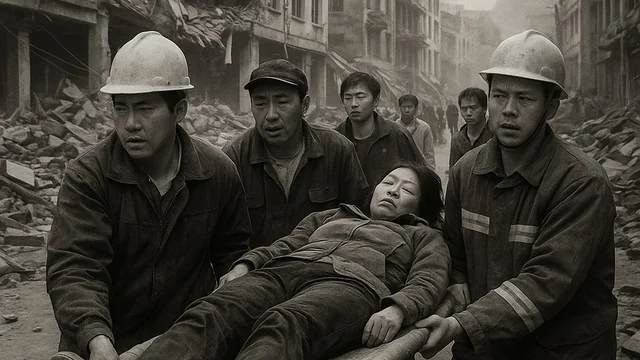
A Dam Built to Withstand Almost Anything
The Banqiao Dam, completed in 1952 along the Ru River in China's Henan province, was engineered with such robust specifications that it earned the informal nickname the iron dam among local residents, reflecting widespread confidence in its ability to withstand even extreme flooding. That confidence would be catastrophically misplaced in August 1975, when Typhoon Nina, a storm that had already weakened considerably after making landfall along China's coast, stalled directly over the dam's watershed and unleashed rainfall totals so extraordinary that they exceeded, by a considerable margin, anything the dam's original design specifications had ever anticipated.
A Year's Worth of Rain in a Single Day
Meteorological records from the disaster remain almost difficult to believe even decades later: some monitoring stations in the region recorded more than 1,000 millimeters of rainfall within a 24-hour period, an amount representing close to an entire year's typical rainfall compressed into a single day. As water levels behind the Banqiao Dam rose far beyond anything its spillway capacity had been designed to release, communication failures, including downed telephone lines and a breakdown in coordination between dam operators and regional flood control authorities, delayed critical decisions about emergency spillway operations and downstream evacuation until it was already far too late.
A Cascading Collapse
On the night of August 8, 1975, the Banqiao Dam failed catastrophically, sending a wall of water estimated at several meters high racing downstream with devastating force. The disaster did not end with a single dam failure, however. The sudden release of water from Banqiao overwhelmed dozens of smaller dams and reservoirs further downstream, triggering a cascading series of at least 62 additional dam failures across the region within hours, a domino effect that dramatically expanded the flood's geographic reach far beyond what the initial Banqiao failure alone would have produced.
A Death Toll Kept Secret for Decades
Estimates of the disaster's death toll vary enormously, generally ranging from approximately 26,000 people killed in the immediate flooding to as many as 240,000 deaths when including subsequent famine and disease outbreaks that swept through the disaster-affected region in the weeks and months that followed, a period during which survivors, many stranded on isolated patches of high ground surrounded by floodwater for days, faced severe shortages of food, clean water, and medical care. For nearly two decades following the disaster, the Chinese government maintained strict secrecy regarding the scale of the catastrophe, and detailed information about the disaster's true toll only became more widely available internationally in the 1990s, following gradual policy shifts toward greater transparency regarding historical disasters and infrastructure failures.
A Catastrophe That Reshaped Global Dam Safety Standards
Once the scale of the Banqiao disaster became more widely known internationally, it prompted significant reassessment among dam engineers worldwide regarding how extreme rainfall events should be incorporated into dam design specifications, particularly for dams situated in regions prone to typhoon-driven rainfall extremes. The disaster remains, by most measures, the deadliest dam failure in recorded history, and it continues to be studied extensively in engineering education as a stark illustration of the catastrophic potential consequences when infrastructure design assumptions fail to adequately account for genuinely extreme, low-probability weather events, a lesson that has taken on renewed relevance as engineers worldwide grapple with how a changing climate may be shifting what counts as a realistic worst-case rainfall scenario for critical infrastructure planning.
A Rebuilt Dam, A Changed Approach
The Banqiao Dam was eventually rebuilt in the years following the disaster with substantially upgraded spillway capacity and structural reinforcements reflecting hard-learned lessons from the 1975 catastrophe, and it remains in active operation today as part of China's broader regional flood control infrastructure. The disaster's long period of enforced secrecy also became, once the story eventually emerged more fully, a frequently cited example in broader international discussions regarding the public health and safety costs of restricting transparency around infrastructure failures, an argument that continues to inform contemporary debates about disaster disclosure policy in countries around the world.