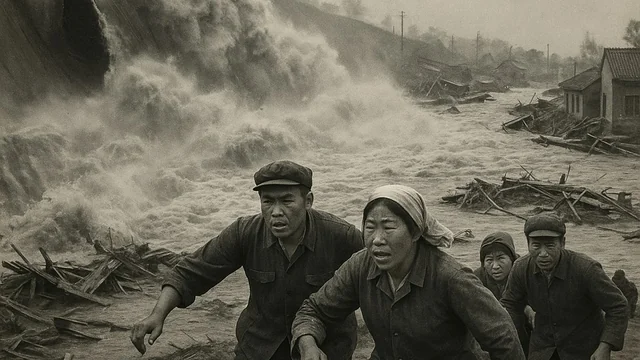
An Afternoon That Shook a Nation
At 2:28 in the afternoon on May 12, 2008, a magnitude 7.9 earthquake ruptured along the Longmenshan fault beneath Wenchuan County in China's mountainous Sichuan province. The timing meant that, unlike many of history's deadliest earthquakes which struck in the dead of night, this one hit during the middle of a school day, a detail that would come to define much of the disaster's most painful legacy. Shaking was felt as far away as Beijing and Shanghai, more than 1,500 kilometers distant, and the rupture zone itself stretched across roughly 240 kilometers of rugged terrain, triggering landslides that buried entire mountain roads and cut off remote communities for days.
The Weight of Collapsed Classrooms
Among the earthquake's nearly 69,000 confirmed deaths, with close to 18,000 more people never found and presumed lost, one category of casualty generated a grief and public anger that outlasted the disaster itself: the collapse of thousands of school buildings, which killed an estimated 5,000 to 10,000 children while many nearby government offices and other structures remained standing. Grieving parents and independent investigators pointed to what became known as "tofu-dreg" construction, buildings thrown up quickly and cheaply, often with corners cut on reinforcing steel and cement quality, in contrast to sturdier public buildings constructed to higher standards. Parents who organized to demand accountability for shoddy school construction faced pressure and, in some documented cases, harassment from local authorities eager to move past the controversy, a tension that continues to shape how the disaster is discussed in China today.
A Response of Staggering Scale
Whatever controversies surrounded specific aspects of the disaster, the scale of China's emergency mobilization was extraordinary. Within hours, the People's Liberation Army had deployed tens of thousands of soldiers to the disaster zone, many arriving on foot or by helicopter where roads had been destroyed by landslides. An unprecedented wave of domestic volunteerism followed, with ordinary citizens from across China traveling to Sichuan to assist with rescue and relief efforts, a level of grassroots civic mobilization that surprised many observers of a society not typically associated with spontaneous public organizing on that scale. International aid and rescue teams were permitted into the disaster zone as well, a notable shift for a government that had historically been cautious about accepting significant foreign assistance following domestic disasters.
Rebuilding an Entire Region
China's reconstruction program following the earthquake was similarly vast, involving the relocation of entire towns away from unstable slopes, the construction of new seismically reinforced schools and hospitals, and a paired assistance program that matched wealthier provinces with specific earthquake-affected counties to fund rebuilding. The heavily damaged town of Beichuan was left largely in ruins as a permanent memorial and museum site, while a new town, Yongchang, was constructed nearby to house displaced residents. Within just a few years, much of the region had been rebuilt with dramatically improved infrastructure compared to what existed before the disaster.
A Fault Line Still Being Understood
The Wenchuan earthquake prompted intense scientific debate over whether the nearby Zipingpu Dam, completed just before the disaster and located close to the fault, may have contributed to triggering the rupture through a phenomenon known as reservoir-induced seismicity, though this remains a contested and unresolved question among seismologists. What is not contested is the earthquake's lasting influence on Chinese disaster policy, from stricter school construction codes to a significantly expanded national earthquake early warning network that has since given residents in earthquake-prone Chinese provinces precious seconds of advance notice before shaking arrives.
Remembering the Fifth of May
Each year on May 12, moments of silence and public commemorations are still held across Sichuan, and the Wenchuan earthquake occupies a place in modern Chinese collective memory not unlike how other nations remember their own defining disasters. The 5.12 Wenchuan Earthquake Museum, built at the ruins of Beichuan, draws visitors from across the country, and the earthquake's imagery, collapsed classrooms, soldiers carrying children through rubble, candlelight vigils held nationwide, remains a frequently referenced touchstone in Chinese media whenever new natural disasters strike, a reminder of both the scale of loss the country endured and the extraordinary mobilization it inspired in response.