How the Appendix Got Its Reputation
The appendix earned its reputation as the body's most dispensable organ largely through the work of Charles Darwin, who described it as a vestigial remnant of the cecum that had served a digestive function in herbivorous ancestors but had shrunk to uselessness in modern humans. For over a century, this interpretation went largely unchallenged — and the fact that people appeared to live normal, healthy lives after appendectomy seemed to confirm it. The organ was so thoroughly dismissed that surgeons routinely removed healthy appendixes during abdominal procedures as a preventative measure.
The rehabilitation of the appendix began in earnest in the 2000s, driven by a combination of anatomical observation and the rapidly expanding science of the gut microbiome.
The Safe House Hypothesis
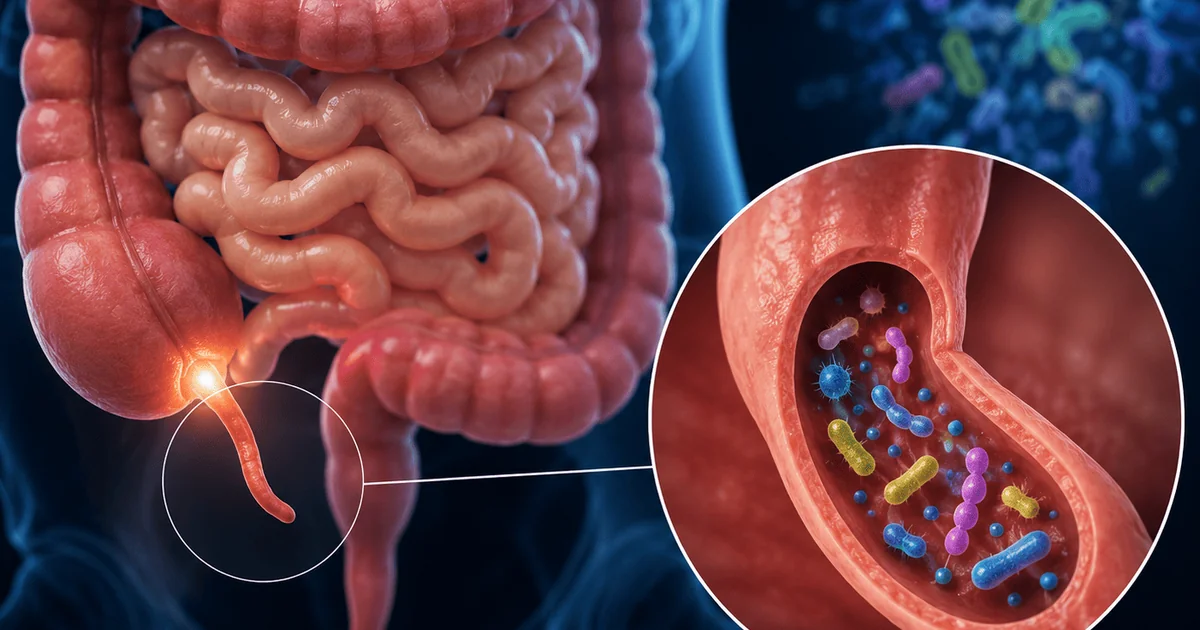
In 2007, surgeons William Parker and Randy Bollinger at Duke University proposed a function for the appendix that was deceptively simple: it acts as a reservoir of beneficial gut bacteria. The appendix is located in the lower right abdomen, positioned at a sort of backwater off the main flow of the large intestine. Its position and its narrow lumen protect its contents from the flushing action that sweeps through the rest of the colon during diarrhoeal illness.
The hypothesis holds that when severe diarrhoea — from cholera, rotavirus, or similar pathogens — clears out the gut microbiome, the bacteria sheltered in the appendix can repopulate the colon once the illness passes. This would explain why the appendix appears in mammals that are exposed to significant pathogen load in their environments, and why it has persisted through evolution despite seemingly serving no digestive function.
Supporting Evidence
The hypothesis has gathered support from several directions. Comparative anatomy studies have found that the appendix has evolved independently in mammals on at least 32 separate occasions — a pattern that is very difficult to explain if it truly serves no function. Structures that are truly vestigial tend to disappear rather than re-evolve. Immunological studies have also found that the appendix is not the inert tube it was once thought to be: it contains a high concentration of lymphoid tissue and appears to play a role in immune system education during early childhood, helping to calibrate appropriate versus inappropriate immune responses to gut contents.
Population-level data has muddied the picture somewhat. Some large studies have found slightly higher rates of Clostridium difficile infection and IBS-like symptoms following appendectomy — consistent with the reservoir hypothesis. Other studies have found no significant effect. The consensus is shifting toward viewing the appendix as a non-essential but functionally meaningful organ — not the useless remnant it was once considered, but also not critical enough that its removal causes obvious, immediate harm in the developed world where appendicitis remains safely treatable by surgery.