The Public Health Classification Nobody Expected
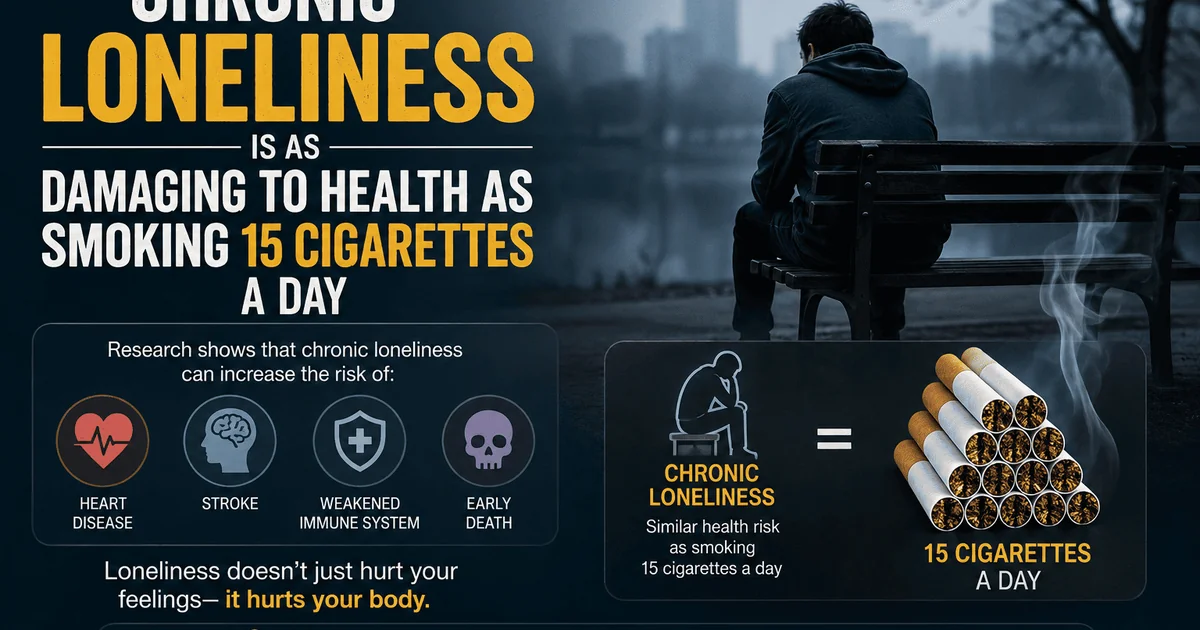
In 2023, the United States Surgeon General issued an advisory declaring loneliness and isolation a public health epidemic, comparing the mortality risk of chronic loneliness to that of smoking 15 cigarettes per day. The UK had already appointed a Minister for Loneliness in 2018 following a commissioned review that found approximately nine million people in Britain often or always felt lonely. These were not soft, social welfare concerns — they were responses to a growing body of research demonstrating that social disconnection kills people at scale.
The mechanism is not metaphorical. Loneliness does not cause death by making people sad. It causes measurable physiological changes that accelerate disease across multiple organ systems simultaneously.
The Inflammatory Response
The most replicated finding in loneliness research is that lonely people show elevated baseline levels of inflammatory markers — particularly interleukin-6 and C-reactive protein — compared to socially connected people matched for age, sex, income and health status. Chronic low-grade inflammation is a feature of nearly every age-related disease: cardiovascular disease, type 2 diabetes, Alzheimer's disease, many cancers. Anything that sustains inflammation above normal baseline levels is effectively accelerating biological ageing.
Researcher John Cacioppo, who spent decades studying loneliness at the University of Chicago, found that lonely people show a distinct gene expression profile in their immune cells — a pattern that down-regulates antiviral responses and up-regulates inflammatory ones. This pattern makes biological sense as a threat-detection mechanism: in ancestral environments, social isolation often preceded predation risk, so the body prepared for physical threat. But in the modern world, sustained activation of this threat-response profile without an actual threat is simply damaging.
Sleep, Cognition and Cardiovascular Effects
Lonely people sleep worse than connected people — not in total duration, but in quality. They spend less time in restorative deep sleep, have more frequent micro-arousals and show higher overnight cortisol levels. This pattern compounds over time: poor sleep increases inflammatory markers, and high inflammatory markers worsen sleep quality. Loneliness also accelerates cognitive decline. A study from Rush University Medical Center found that lonely people had a 64 percent higher risk of developing clinical dementia over a ten-year follow-up period, even after controlling for depression, which is closely associated with but distinct from loneliness.
Cardiovascular effects are equally consistent. A meta-analysis covering 182 studies found that loneliness and social isolation were associated with a 29 percent increased risk of heart disease and a 32 percent increased risk of stroke. The effect sizes are comparable to those of well-established cardiovascular risk factors like hypertension and obesity.
Why Connection Is Medicine
The converse of this research is that social connection has genuinely protective physiological effects. Strong social ties are associated with faster wound healing, better immune responses, lower inflammatory markers and reduced cortisol reactivity to stress. Older adults with strong social networks show slower cognitive decline. The research from the Harvard Study of Adult Development — the longest-running study of adult life ever conducted, following men from 1938 into old age — concluded that close relationships were the single strongest predictor of late-life health and happiness, more powerful than genetics, income or any other factor measured.
This does not mean the solution to the loneliness epidemic is simply "make more friends." Loneliness is partly a matter of circumstance and partly a function of the way chronic isolation alters perception — lonely people tend to read social situations as more threatening and relationships as less trustworthy, which makes reconnection harder. Addressing it at a societal level requires design: communities, workplaces and urban environments built around human connection rather than efficiency.